When You Say Something, Mean It
As we continue through the book, "What Great Teachers Do Differently- 17 Things That Matter Most", by Todd Whitaker, we will review the previous 2 weeks.
1. It's People, Not Programs
2. The Power of Expectations
Now we will examine the chapter titled, "If you say something, mean it". This chapter is exactly as the title describes. Great teachers follow through with what they say they are going to do. This chapter focuses primarily on classroom management, but I believe it can apply to all facets of things including, but not limited to, helping organize school events, meeting preparation, attending student events, etc... It's not about how many things you are involved in or how many events you attend, it's about following through when you say you will do something.
In terms of discipline, if you say there is going to be a consequence, then follow through on your consequence. If kids know you don't follow through on consequences, they will push you to the limit, thus disrupting quality instructional time. Whitaker also points out that, although follow through is important, so is how you deal with the misbehavior. For instance, often times you can acknowledge a behavior, without letting the whole class know you have seen the behavior. Often times the student misbehaving is seeking attention. By acknowledging the misbehavior in a loud way, you are giving the student what they want, attention. So communicating the consequence is often times just as important as following through on the consequence.
"Great teachers manage their classrooms thoughtfully. When they say something, they mean it (Whitaker, 24)."
Showing posts with label classroom management. Show all posts
Showing posts with label classroom management. Show all posts
Thursday, October 13, 2016

Friday, April 29, 2016
5 Practices That Provoke Misbehavior
5 Practices That Provoke Misbehavior
It's the end of the year, the weather is getting nice, everyone can see the light at the end of the tunnel. This is a prime time for student misbehavior. Sometimes the misbehavior is on the kids, but other times it can be our classroom management, or simply the way in which we do things in the classroom. ASCD published a great article in Educational Leadership from the October 2015 edition. It is well worth the read as well as the time to reflect on our own practices.
5 Practices That Provoke Misbehavior by Eric Toshalis
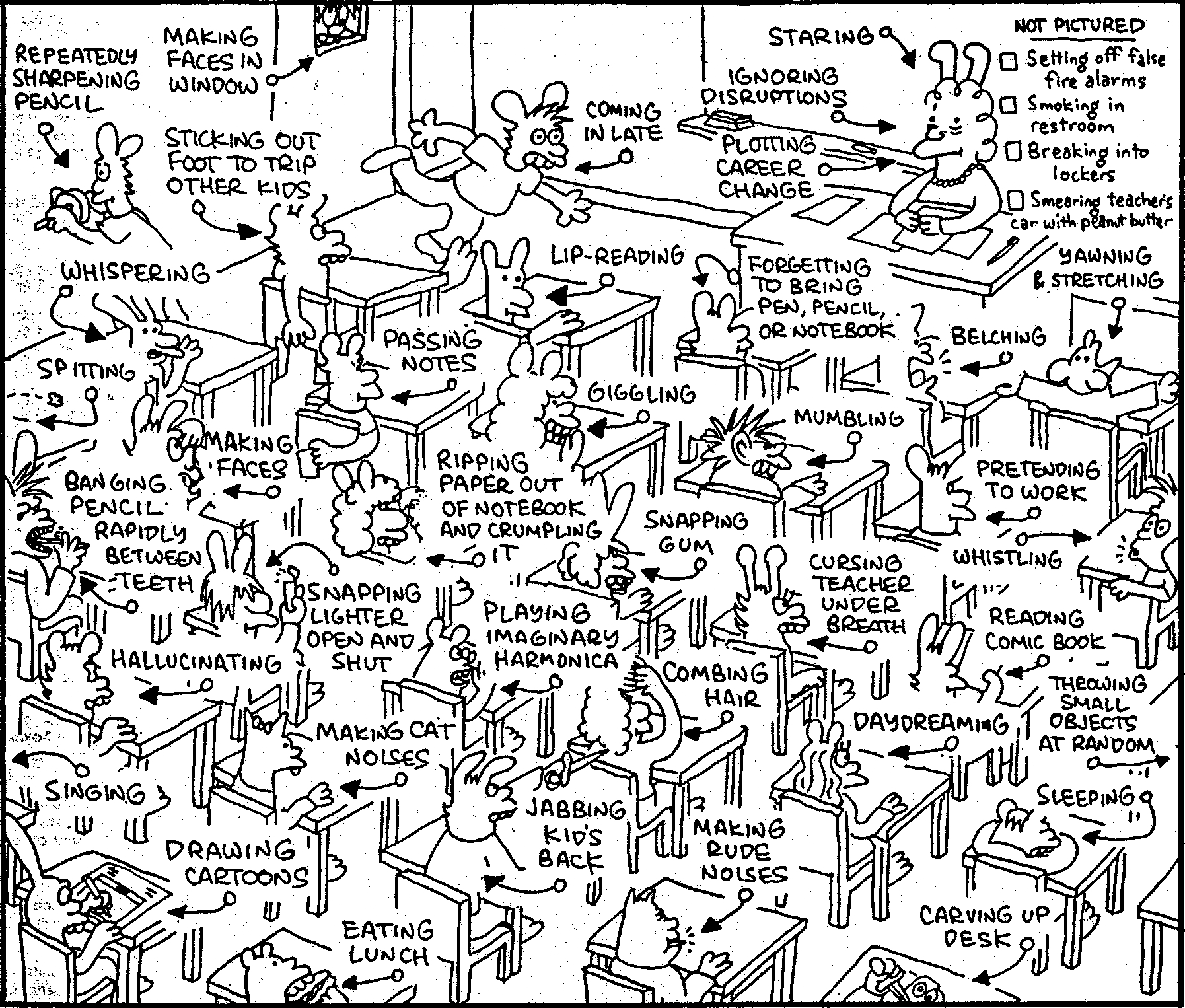
It's the end of the year, the weather is getting nice, everyone can see the light at the end of the tunnel. This is a prime time for student misbehavior. Sometimes the misbehavior is on the kids, but other times it can be our classroom management, or simply the way in which we do things in the classroom. ASCD published a great article in Educational Leadership from the October 2015 edition. It is well worth the read as well as the time to reflect on our own practices.
5 Practices That Provoke Misbehavior by Eric Toshalis
Friday, May 9, 2014
First Days of School - How to Have Students Follow Classroom Procedures
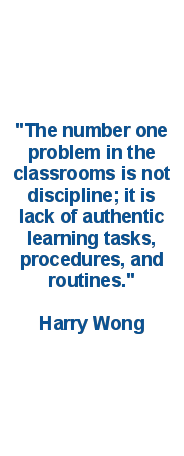
"The number one problem in the classroom is not discipline; it is the lack of procedures and routines."
Procedures and routines are one of the most important aspects to managing your classroom. Effective teachers have procedures and routines (PR) for everything, and the students are well versed in the procedures and routines. PR's need to be explicitly taught to your students. It is a mistake to assume that students know how you want things done by just telling them how you want it done. Practice makes perfect!
Procedures vs Discipline
A procedure is a method or process for how things are to be done in the classroom. Do not confuse PR's with your discipline plan.
- Discipline concerns how students behave.
- Procedures concern how things are done.
- Discipline has rewards and penalties.
- Procedures have no penalties or rewards.
An example of a procedure is opening a combination lock. If you do not follow the procedure, the lock does not open. There is no penalty for not following the procedure other than your lock simply does not open. If you follow the procedure correctly, the lock opens. Likewise, there is no reward for following the procedure other than the lock simply opening.
Importance of Procedures
A procedure is how you want something done. It is your responsibility to state clearly how you want a certain task completed. A routine is what the student does automatically without prompting. A routine becomes a habit.
- Procedures are statements of student expectations necessary to participate successfully in classroom activities...
- Procedures allow for many different activities to take place efficiently in the classroom.
- Procedures increase on-task time and greatly reduce classroom disruptions.
- Procedures tell a student how things operate in a classroom, thus reducing discipline problems.
Examples of Classroom Procedures
This list below is not an all-encompassing list of procedures in the classroom. The list is provided for you to think about how these procedures are completed in your classroom, and if the students fully understand those procedures.
| Possible Classroom Procedures | ||
|---|---|---|
| End of the period or class | End of the day | Walking in the hallway |
| Starting class | Transition from activity | Asking for help |
| Taking attendance | Using the restroom | Going to the office |
| Using the trashcan | If you forgot something | Passing in papers |
| Late work | Fire drill | Tornado drill |
| Lockdown | Gathering supplies | Group work |
| When you are tardy | Band lesson | Substitute Teacher |
The Three-Step Approach to Teaching Procedures
"Most behavior problems in the classroom are caused by the teacher's failure to teach students how to follow procedures." (Wong, 174)
3 Step Process
- Explain - State, explain, model, and demonstrate the procedure.
- Use concrete terms
- Demonstrate, step by step
- Rehearse - Practice the procedure under your supervision.
- Actually practice the procedure
- Repeat until it becomes routine
- Reinforce - Reteach, rehearse, practice, and reinforce until the procedure becomes a routine or habit.
- Praise students once procedure has become a routine
Be sure to teach the students how you want certain procedures completed from the beginning of the year. If you don't teach the procedure from the start, you will face an uphill battle all year long. The time spent teaching the procedure is well worth it in the long run. By teaching procedures, you will actually gain time in your classroom as students will not need to ask questions or be confused as to what they are to do.
Friday, May 2, 2014
First Days of School - Having an Effective Discipline Plan
"If you fail to plan, you plan to fail."
"Effective teachers introduce rules, procedures, and routines on the very first day of school and continue to teach them the first week of school."
The teacher is responsible for communicating and maintaining behavior. The most successful classes are those in which the teacher has a clear idea of what is expected from the students and the students have a clear idea of what the teacher expects from them.
- Rules are expectations of appropriate student behavior.
- Decide on your rules and post them prior to the first day of school.
- Clearly communicate in both written and verbal your expectations.
- It is easier to maintain good behavior than to change inappropriate behavior that has been established.
- Rules immediately create a work-oriented atmosphere.
- Rules create a strong expectation about the things that are important to you.
Two Kinds of Rules
"The function of a rule is to prevent or encourage behavior by clearly stating student expectations." (Wong, 145) There are two kinds of rules; general and specific. Each serves their own purpose.
- General Rules
- Respect others.
- Be polite.
- Keep the room clean.
- Specific Rules
- Be in class and in your seat before the bell rings.
- Do no swear.
- Have all materials ready to use.
The advantage of general rules are they are flexible and are open to interpretation to meet the needs of many situations. One disadvantage to a general rule is that they sometimes need to be defined further for students. An advantage of specific rules that they clearly state what is expected of the students. A disadvantage to having specific rules is that there needs to be many rules to meet the needs of the full classroom.
Introducing the Rules
You should have between 3-5 rules posted in your classroom. Any more than 5 rules and students have a hard time remembering. As you go over the rules with your class, remember to state the rules are to keep them safe and allow everyone in the class to learn. The rules should be posted permanently somewhere in the room and also given to students to have in their notebook or folders.
Students can be involved in the creating of the rules, but their role is somewhat limited. There are certain district and school-wide rules that must be adhered to. You, as the teacher, also have expectations that need to be met. When all is said and done, there maybe is room for the students to create one or two rules.
Consequences
Rules are most effective when there are consequences. There are two kinds of consequences; positive and negative. All discipline plans need to have consequences. The consequences need to be posted as well. If you do not involve your students in the creation of the rules, creating consequences would be a great place for students to get involved. A typical sign outlining consequences could look like this:
- If you choose to break a rule
- 1st time: Name on the board
- 2nd time: 15 minutes after school with teacher
- 3rd time: Lunch with the teacher
- etc...
- If you choose to follow the rules:
- Game day on Friday afternoon, or movie day, playground time, etc...
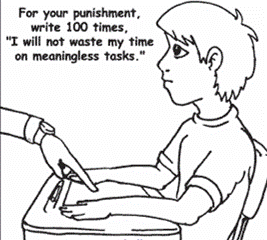
Consequences must also be reasonable and logical. A reasonable consequence is on that follows logically from the behavior rather than one that is arbitrarily imposed. For example a student turns in a project that is unreadable. The logical consequence would be to redo the project (or parts that are unreadable). The illogical consequence would be to write a paper on how being sloppy will hurt the student in the long run. Any consequences given out for behavior should be related to behavior. Deducting points on an assignment due to behavior is not a logical consequence.
Support
After your rules and consequences are established, the teacher should get support from administration, colleagues, and parents. You must have administrative support to make sure your consequences or rules do not violate any school or board policies. You will also need their support if you need to remove a student from your classroom for an infraction of the rule. Your discipline plan also needs support from other faculty members to ensure everyone is "on board" with classroom expectations.
You should acquire parental support for your discipline plan as well. This can simply be sending your discipline plan home with a parent and student signature at the bottom. Sending your plan home for students to go over with parents is important because if the student breaks one of the rules, the consequence is no surprise for the parents.
Wrapping it Up
Creating a discipline plan is often an overlooked part to classroom management. Having something written down and posted creates an environment where everyone knows what is happening. Getting the support of administration, faculty, and parents is also another crucial aspect to creating an effective discipline plan. Keep it simple, keep consequences logical and reasonable and everyone will be happy.
Friday, April 25, 2014
The First Days of School - Posting Assignments and Taking Attendance
"Your very first priority when the class starts is to get the students to work." (Wong, 121)
Classroom management begins the moment the bell rings to signify the start of class (actually before that...). How you manage the first 5 minutes of class is vitally important. If we allow our students to hand in makeup work, ask to go to the bathroom, take roll, etc... we have wasted 5 minutes of 95% of the students in the classrooms time. Add up this 5 minutes over the course of a week and you get 25 minutes per week of wasted time, 100 minutes per month, potentially more than 850 minutes per year if we start class without a plan!
Have a Plan
Last week we talked about Prior Planning Preventing Poor Performance. Keeping this in mind, we need to have a plan for the first 5 minutes of class. Typically questions are asked at the beginning of the period such as:
- What are we doing today?
- Was that assignment due today?
- Is there going to be an assignment?
In order to alleviate many of these questions, a teacher could simply post their plan or agenda for the day on the board. Your plan should include, what you are doing today, what is due for today, and what will be due tomorrow. I used to call this my "Do-Due" page. Kids would remind me to post my "Do-Due". This information should be in the same spot every day. This way kids know what to expect, eliminating many of the anticipated questions.
Posting your plan also assists your paraprofessionals helping students in your classroom. It can also serve as a guide for your administrator who is walking through observing. Learning targets should also be posted as part of this daily plan.
When and How to Take Attendance
Taking attendance is an important process in the classroom, but it should not take up any of your class time. Roll-taking does not concern the class, so do not concern the class with the process. Wong states, "the effective teacher starts the class immediately with an assignment, not roll taking." (Wong, 127)
A typical roll-calling scene involves a teacher reading names off a list and the student responding with "here". Think about the time it takes to get through the list of names, the many excuses as to why "Johnny" isn't in class, the jokes that are made, etc... With all this disruption, the class does not start effectively and efficiently.

Outcomes of Ineffective Roll Taking
- Noise level continues to rise.
- Cause confrontation between teacher and student about why a student is absent.
- Valuable time is wasted.
- Students start class bored while roll is taken.
Effective Ways to Take Attendance
- Use a seating chart to take attendance, mark on the chart and notify office at a later time.
- Have folders with student work in a file or box at the door. Students grab their folder on their way in. The folders that are still in the box are those of students that are absent.
- Use a clothespin with a chart. Students walk in and move the pin to present or you can even do lunch choices. No more having to go around the room and ask about lunch choices.
"Effective teachers take roll quickly and quietly without disturbing the class."
Thursday, April 17, 2014
The First Days of School - Introduce Yourself to Your Class
"Right or wrong, accurate or not, your reputation will precede you."
Like Harry Wong says, it may not be right, but your reputation will definitely precede you. Whether you like it or not, students and parents talk about you. If you have a good reputation, students will enter your class with high expectations. If you have a bad reputation, students enter your classroom with low expectations and bad attitudes. "Protect your reputation and create a positive image. You have nothing to lose and everything to gain." (Wong, 102)
Preschool Invitation
You can set the tone of who you are and what you stand for before school even begins. Here are a couple strategies you can do to introduce yourself to your parents and students.
- Send a letter home to parents before school begins
- Tell them you look forward to working with their child.
- Include any important dates, including open house.
- Include any materials their child should have for your class.
- Send a letter home to each student before school begins
- Include a welcoming message.
- Tell the students who you are.
- If they have questions before school starts, how will they get in touch with you?
- List materials they will need on the first day.
- List your expectations.
The First Day
Greeting your students on the first day of school, might be the most important thing you do all year! It sets the tone for the whole school year.
- Stand at the door with a big smile and a ready handshake.
- Be sure you have the following information by your classroom door.
- Your name, room number, subject/grade level, an appropriate welcome or greeting.
- Greet each student with a handshake.
- Have instructions on the board as to where to sit and what to do.
- Have the 1st assignment ready; this can be something simple and not graded (Example: information form).
"Everything possible should be done to welcome the students and to make sure that they know where to go and how to get there on time." (Wong, 107)
How Students Enter the Classroom
You should have expectations as to how students will enter your classroom. If a student does not enter the classroom correctly, have that student come back to the door and correct the behavior. Ask the student nicely and tell the student why they have to correct their actions. You need to begin teaching routines from the moment you meet your students at the door. Don't forget what you learned in the previous chapters about using the students name and saying please and thank you :)
Important First Words
What you say to start your class on the first day of school can set the tone for the rest of the year. There are two things you want to state at the outset on the first day of school; your name and your expectations. Be sure to tell the students how you wish to be addressed. For example: "My name is Mr. Raymo, and I would like to be addressed as such, please. Thank you! " Students really want to know who you are as a person, so tell the class who you are.
Some of this may seem like common sense, but if you are struggling with classroom management, look back to how you started the year. You can also not only look back to the beginning of the year, but how do you start each class period. Are you prepared with a "bell ringer" activity or do students sit and visit while you take roll and deal with the other distractions?
Friday, April 11, 2014
First Days of School - The Ready Classroom
"Teachers who are ready maximize student learning and minimize student misbehavior."
As we continue our First Days of School series, we will look at the ready classroom. Wong starts by comparing the classroom to a restaurant. When you go to eat at a successful restaurant, the table is ready, the dining room is ready, and the staff is ready. Aside from good food and service, being ready is a large part to being a successful business. A successful teacher is ready; their work is ready, the room is ready, and the teacher is ready. When you walk into a restaurant, office, or store, you expect them to be ready; why would you expect anything less from yourself?

Prepare the Floor Space
- Make sure you have enough desks and chairs.
- Fix broken furniture.
- Be friendly with your custodian, they are there to help prepare your classroom.
- Place desks and chairs where students can easily see the teacher.
- Keep high-traffic areas clear.
- Have a strategic location ready for students who need to be isolated from the whole group.
Prepare the Work Area
- Arrange work area so all students can be monitored from any place in the room.
- Make sure you have enough chairs.
- Be sure to have all necessary supplies.
- Test any equipment.
Prepare the Student Area
- Provide a space or routine for students to place their belongings they bring to class.
- Have a "lost and found" area.
Prepare the Wall Space
- Prepare a bulletin board to be used for student work.
- Discipline plan should be in a prominent place.
- Post procedures, schedules, charts, maps, directions, etc... in a prominent place.
- Have a consistent place for listing the day's work and/or learning target.
- Have a display for the feature topic or theme.
Prepare the Bookcases
- Rotate materials on the shelf.
- Do not place bookshelf near an exit where it may block the exit.
Prepare the Teacher Area
- Place teacher desk in a spot that does not place a barrier between the students and the teacher.
- Teacher desk should be in a spot where you can easily monitor behavior from.
- If you have lots of personal belongings in your desk, make it clear from the beginning the rules and procedures for going into your desk.
Prepare the Teaching Materials
- Have all basic materials ready and handy. (Paper, pencils, erasers, markers, crayons, glue, etc...)
- Store seldom-used materials out of the way.
- Have a method ready for seating the students.
Prepare Yourself
- Keep your personal belongings in a safe place.
- Know where your emergency materials are.
- Know procedures for fire, tornado, or lock down drill.
"Teachers who are ready maximize student learning and minimize student misbehavior."
One of my professors in college had a phrase he used frequently, and it is one that I will never forget;
"Prior Planning Prevents Poor Performance"
Friday, April 4, 2014
First Days of School - Classroom Management
Classroom Management
The second characteristic of an effective teacher is being a good classroom manager. The next part in Wong's book talks about classroom management strategies. This will be the focus of this series for the next couple weeks.
"Effective teachers MANAGE their classrooms. Ineffective teachers DISCIPLINE their classrooms"
Classroom management refers to all of the things that a teacher does to organize students, space, time, and materials so that instruction in content and student learning can take place (Wong, 84). Linking back the previous section, Wong says, "The most important thing a teacher can provide in a classroom...is security" (Wong, 85).
Characteristics of a Well-Managed Classroom
- Students are deeply involved with their work, especially with academic, teacher led instruction.
- Students know what is expected of them and are generally successful.
- There is relatively little wasted time, confusion, or disruption.
- The climate of the classroom is work-oriented, but relaxed and pleasant.
| Techniques | |
|---|---|
| Characteristics | Effective Teacher |
| High level of student involvement with work | Students are working. |
| Clear student expectations | Students know that assignments are based on objectives. Students know that tests are based on objectives. |
| Relatively little wasted time, confusion, or disruption | Teacher has a discipline plan. Teacher starts class immediately. Teacher has assignments posted. |
| Work-oriented but relaxed and pleasant climate | Teacher has invested time in practicing procedures until they become routines. Teacher knows how to bring class to attention. Teacher knows how to praise the deed and encourage the student. |
Here are a couple ending quotes from this chapter on classroom management:
"A well-managed classroom is a task-oriented and predictable environment." (Wong, 88)
"It is the responsibility of the teacher to manage a class to see that a task-oriented and predictable environment has been established." (Wong, 88)
During the next couple weeks we will be looking at the different aspects of a well-managed classroom, according to Harry Wong.
Friday, March 7, 2014
New Series - The First Days of School
 During the months of January and February we highlighted a feature called Brandon's Brainwork. I hope it gave you the opportunity to reflect and think about a few aspects of your teaching. Our last series of the year will be based on The First Days of School by Harry & Rosemary Wong. Each week we will highlight a certain chapter in the book and provide resources to go with the chapters.
Laying the Groundwork
According to Harry Wong, the three characteristics of an effective teacher are:
- Has positive expectations for students success.
- Is an extremely good classroom manager.
- Knows how to design lessons for student mastery.
Over the next couple months we will highlight different pieces of each of these three characteristics.
Positive Expectations
- AKA...High expectations.
- Means that the teacher believes in the learner and that the learner can learn.
- Whatever the teacher expects from the learner is what the learner will produce.
- It is essential that the teacher exhibit positive expectations toward all students.
Classroom Management
- Practices and procedures that a teacher uses to maintain an environment in which instruction and learning can occur.
- Discipline has very little to do with classroom management.
- The teacher must establish a productive and cooperative working environment.
Lesson Mastery
- Student's demonstration that a concept has been comprehended or a skill can be performed at a level of proficiency determined by the teacher.
- Student success in the subject matter of the class will be the result of how well the teacher designs lessons and checks for mastery.
Friday, February 7, 2014
Brandon's Brainwork-Classroom Management
Classroom Management
 Classroom management is one of those things that every teacher can improve on. One of the best books on classroom management is Harry Wong's The First Days of School. If this book is not in your professional library, it should be! Harry Wong defines classroom management as "all the things that a teacher does to organize students, space, time, and materials so learning can take place". Each person handles classroom management in their own unique way, but there are a couple characteristics that define a well managed classroom. According to Wong, they are:
- Students are deeply involved in their work.
- Students know what is expected of them.
- There is relatively little wasted time.
- The climate of the classroom is work-oriented but also relaxed.
A couple strategies Wong gives for classroom management are:
- Start the class with an assignment, not roll.
- Post your assignments in the same place and manner every day.
- Permanently display your classroom rules and expectation.
- Have procedures for everything! Teach and practice the procedures.
- Dismissal at the end of class
- When students are absent
- For quieting the class
- Handing in papers
- Starting the class
- Be over-prepared!
Reflection Questions
1. Are you over-prepared every day?
2. Do you have consistent procedures for everything in your classroom?
3. Did you, or have you, practiced the procedures?
4. What part of classroom management am I strong in? What can I share with a colleague that would help them with classroom management?
5. What area of classroom management am I weak in?
Resources
Harry Wong- The First Days of School & Professional Reference
Subscribe to:
Comments (Atom)