Tonka Institute
If you are looking for some good, high quality, professional development this summer, the Tonka Institute is the place for you! This year they have a variety of speakers on 3 very important topics in education. Below, you will find more information on the Tonka Institute. More information can be found by going to the Minnetonka Institute for Educational Leadership website.
Please plan to join us for the 7th annual Minnetonka Institute for Educational Leadership! We hope that you can leverage this line-up of thought-provoking speakers to accelerate professional development and growth in your district. Each day of the institute will feature an important area of interest for educators as well as engaging experts who will offer keynotes, workshops, and other special opportunities. Here is the list of dates, themes, and speakers:
Monday, June 15, 2015 – Interventions and Achievement Gap
• George Batsche (from the RTI Action Network)
• Yvette Jackson (author of Aim High, Achieve More and The Pedagogy of Confidence)
Tuesday, June 16, 2015 – Innovation in Education
• George Couros (Blog: The Principal of Change)
• Heather Staker (author of the new book Blended with Michael Horn)
• Eric Scheninger (author of the new book Digital Leadership)
• Patti Drapeau (author of the new book - Sparking Student Creativity: Practical Ways to Promote Innovative
Thinking and Problem Solving)
Wednesday, June 17, 2015 – Assessment and Grading
• Doug Reeves (Director of Leadership and Learning Institute)
• Rick Stiggins (Director of the Assessment Training Institute – appearing via live feed)
• Nicole Vagle (national speaker on the topic of standards-based grading)
• Jeff Erickson (Minnetonka principal and author of scholarly articles on standards-based grading)
Wednesday, June 17, 2015 - Technology Half & Full Day Workshops
Thursday, June 18, 2015 – Technology Institute
• Tom Murray (leader of #edtechchat and Tech Consultant at Alliance for Excellent Education)
• Greg Kulowiec and Beth Holland (EdTechTeacher consultants)
• Area Technology Leaders and TIES Staff
Showing posts with label assessment. Show all posts
Showing posts with label assessment. Show all posts
Friday, January 30, 2015

Friday, December 19, 2014
Repair Kit for Grading - Fix 13
The past 12 weeks we have been focusing on Ken O'Connor's 15 Fixes for Broken Grades. I highly suggest reading through the whole book, it will change the way you approach grading in your classroom. It's a very quick read, and well worth the time!
Fixes 1-6: Fixes for practices that distort achievement
Fixes 7-10: Fixes for low-quality or poorly organized evidence
Fixes 11-12: Fixes for Inappropriate Grade Calculation
Fixes 1-6: Fixes for practices that distort achievement
Fixes 7-10: Fixes for low-quality or poorly organized evidence
Fixes 11-12: Fixes for Inappropriate Grade Calculation
- Don't include student behaviors in grades; include only achievement.
- Don't reduce marks on "work" submitted late; provide support for the learner.
- Don't give points for extra credit or use bonus points; seek only evidence that more work has resulted in a higher level of achievement.
- Don't punish academic dishonesty with reduced grades; apply other consequences and reassess to determine actual level of achievement.
- Don't consider attendance in grade determination; report absences separately.
- Don't include group scores in grades; use only individual achievement evidence.
- Don't organize information in grading records by assessment methods or simply summarize into a single grade; organize and report evidence by standards/learning goal.
- Don't assign grades using inappropriate or unclear performance standards; provide clear descriptions of achievement expectations.
- Don't assign grades based on student's achievement compared to other students; compare each student's performance to preset standards.
- Don't rely on evidence gathered using assessments that fail to meet standards of quality; rely only on quality assessments.
- Don't rely only on the mean; consider other measures of central tendency and use professional judgment.
- Don't include zeros in grade determination when evidence is missing or as punishment; use alternatives, such as reassessing to determine real achievement, or use "I" for incomplete or insufficient evidence.
The last 3 fixes are fixes to support learning.
Fix 13: Don't use information from formative assessments and practice to determine grades; use only summative evidence.
Formative assessments are assessments for learning. They are used to gather information about what to do next in the classroom. FA's primary purpose is to see if and who needs reteaching. It is not punitive or rewarding for the student, so why would you use them for points? Formative assessments should never be used to determine grades. Once a teacher does an assessment of learning (summative) those can be counted towards a grade. As mentioned in previous weeks though, in a standards-based reporting system, this is a non-issue. You either exceed, meet, partially meet, or do not meet the standard.
 Also a part of this issue is the debate as to what should truly be graded. There are some teachers that grade everything and there are some teachers that grade very little. So what is the magic formula? The answer lies in your philosophy of teaching and learning. The one piece of advice that has swayed my thinking, and I do not recall who it came from,, "learning is a process and we make mistakes through this process".
This makes me think about what am I grading, the learning, or what has been learned? Why are we punishing kids for making mistakes along the way to learning something? Grades do not need to be punitive or rewarding. They should reflect what students know and are able to do.
This makes me think about what am I grading, the learning, or what has been learned? Why are we punishing kids for making mistakes along the way to learning something? Grades do not need to be punitive or rewarding. They should reflect what students know and are able to do.
Friday, November 21, 2014
Repair Kit for Grading - Fix 10
Fix 10: Don't rely on evidence gathered using assessments that fail to meet standards of quality; rely only on quality assessments.
If your assessments are assessing information and/or standards that are not pertinent to the grade level or class, then why are you assessing? The assessments need to have:
If your assessments are assessing information and/or standards that are not pertinent to the grade level or class, then why are you assessing? The assessments need to have:
- Clear Purpose
- What's the purpose?
- Who will use the results?
- What will they use the results for?
- Key Targets
- What are the learning targets?
- Are they clear?
- Are they appropriate?
- Sound Design
- What method?
- Quality questions?
- Sampled how?
- Avoid bias how?
- Effective Communication
- How to manage information?
- How to report? To whom?
- Student Involvement
- Students are the users
- Students need to understand the targets
- Students can track progress and communicate too
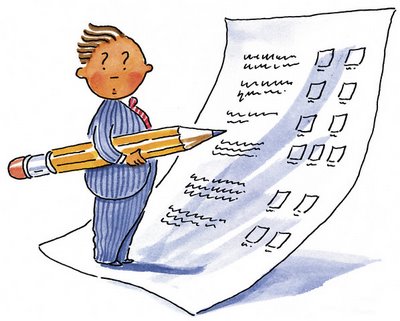
When creating an assessment it is important to make sure it:
- Relates to the learning goal
- Is at the level the standard calls for
- Is appropriate
- Questions are clear
If your assessments do not meet any of the criteria listed above, your data will be inaccurate and results will be skewed.
Friday, September 12, 2014
Tech Tip - Kahoot
Kahoot
If you are looking for a way to do fun review in your classroom, pull in a set of devices and play Kahoot with your kids. Kahoot is a great tool for all ages. It is a game-based way to assess. Teachers can either create their own questions, or select a quiz from the many quizzes already created in the public gallery. Kahoot requires no student signup, so playing a game in your class takes very little time. Give it a try during the first couple weeks of school.
Kahoot Tutorial Video
Friday, October 4, 2013
12 Touchstones of Good Teaching
4. Measure Understanding
 What it looks like: Course grades should reflect what a student knows, not what a student does or how he/she acts. (Goodwin & Hubbell, pg. 196)
Why it is important: Grade inflation gives students a false impression they have learned something. Students learn how to play school, rather than learn material. Grading nonacademic factors also lowers expectations for students. (Goodwin & Hubbell, pg. 196)
Why it is important: Grade inflation gives students a false impression they have learned something. Students learn how to play school, rather than learn material. Grading nonacademic factors also lowers expectations for students. (Goodwin & Hubbell, pg. 196)
Goodwin, B., & Hubbell, E. R. (2013). The 12 Touchstones of Good Teaching: A Checklist for Staying Focused Every Day. Alexandria, VA: ASCD - See more at: http://www.mcrel.org/products-and-services/products/product-listing/100_199/product-111#sthash.NJswMvKe.dpuf

Subscribe to:
Comments (Atom)