Pages

Showing posts with label A Repair Kit for Grading. Show all posts

Friday, November 6, 2015

Grading Practices Books

Grading Practices Books
One of our focuses this year in the best practice meetings has been on grading practices.  The groups spend time discussing and reflecting on their own grading practices.  Each group has had stellar conversation over this topic, and many people have walked away from the MRVED with a different view on grading.  With that being said, here are some book suggestions to support your learning on grading practices.

Guskey, Thomas R. On Your Mark, Challenging the Conventions of Grading and Reporting. Bloomington, IN: Solution Tree, 2015. Print.

Guskey, Thomas R., and Jane M. Bailey. Developing Standards-Based Report Cards. Thousand Oaks, CA: Corwin, 2010. Print.

O'Connor, Ken. A Repair Kit for Grading, 15 Fixes for Broken Grades. Boston, MA: Pearson, 2011. Print.

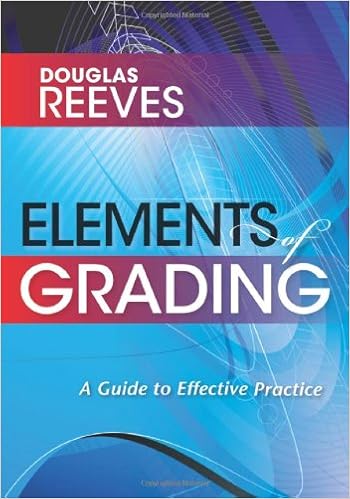
Reeves, Douglas. Elements of Grading, A Guide to Effective Practice. Bloomington, IN: Solution Tree, 2011. Print.


Friday, January 16, 2015

Repair Kit for Grading - Fix 15 & Conclusion

Fix 15: Don't leave students out of the grading process.  Involve students; they can, and should, play key roles in assessment and grading that promote achievement.

Students need to be involved in the grading process and should understand how and why they are being graded.  Grading should be transparent, not only for student use, but parent and administrator use as well.  Be clear in what you are grading.

Conclusion
The past 15 weeks we have been focusing on Ken O'Connor's 15 Fixes for Broken Grades.  I highly suggest reading through the whole book, it will change the way you approach grading in your classroom.  It's a very quick read, and well worth the time!

Fixes 1-6: Fixes for practices that distort achievement
Fixes 7-10: Fixes for low-quality or poorly organized evidence
Fixes 11-12: Fixes for inappropriate grade calculation
Fixes 13-15: Fixes to support learning
  1. Don't include student behaviors in grades; include only achievement.
  2. Don't reduce marks on "work" submitted late; provide support for the learner.
  3. Don't give points for extra credit or use bonus points; seek only evidence that more work has resulted in a higher level of achievement.
  4. Don't punish academic dishonesty with reduced grades; apply other consequences and reassess to determine actual level of achievement.
  5. Don't consider attendance in grade determination; report absences separately.
  6. Don't include group scores in grades; use only individual achievement evidence.
  7. Don't organize information in grading records by assessment methods or simply summarize into a single grade; organize and report evidence by standards/learning goal.
  8. Don't assign grades using inappropriate or unclear performance standards; provide clear descriptions of achievement expectations.
  9. Don't assign grades based on student's achievement compared to other students; compare each student's performance to preset standards.
  10. Don't rely on evidence gathered using assessments that fail to meet standards of quality; rely only on quality assessments.
  11. Don't rely only on the mean; consider other measures of central tendency and use professional judgment.
  12. Don't include zeros in grade determination when evidence is missing or as punishment; use alternatives, such as reassessing to determine real achievement, or use "I" for incomplete or insufficient evidence.
  13. Don't use information from formative assessments and practice to determine grades; use only summative evidence.
  14. Don't summarize evidence accumulated over time when learning is developmental and will grow with time and repeated opportunities; in those instances, emphasize more recent achievement.
  15. Don't leave students out of the grading process.  Involve students, they can, and should, play key roles in assessment and grading that promote achievement.
The goal of this series over the past 4 months was to get you to examine your grading practices.  In order to make any change, one must first realize and understand what the purpose of a grade is.  The purpose of a grade is to communicate what a student knows and is able to do.  Without this clear understanding, teachers tend to lump behaviors and expectations into grades, thus inaccurately reporting what a student knows and is able to do.  I highly recommend Ken O'Connor's book on grading.  He provides fixes that are practical for any classroom and will give you a more accurate picture of where your class is.

If you are looking to go deeper into standards-based grading, which was referenced many times over the past 4 months, I suggest looking at Thomas Guskey and Jan Bailey's book Developing Standards-Based Report Cards.

Friday, January 9, 2015

Repair Kit for Grading - Fix 14

Fix 14: Don't summarize evidence accumulated over time when learning is developmental and will grow with time and repeated opportunities; in those instances, emphasize more recent achievement.

This fix encompasses many different things.  The prime example for this fix is the student who has scores like this:

  • Homework 1 - 10/20
  • Homework 2 - 8/20
  • Homework 3 - 6/20
  • Quiz - 14/20
  • Homework 4- 14/20
  • Homework 5 - 12/20
  • Homework 6 - 10/20
  • Test - 48/50
According to the test score the student learned what he/she was supposed to learn.  With all categories being equal the student has a 64% for this unit, when the student got a 96% on the summative assessment.  Like the previous week, are we grading the learning or what was learned?

Analogy:  If I am running a race, it doesn't matter what position I started in, nor does it matter the position I was in for most of the race.  The only thing that matters is where I finish.  If I have accomplished my goal of finishing first, should I punish myself for not starting in the 1st position?

This is another concept that requires rethinking grading formative assessments and practice.  It is a change in some teaching philosophy that requires deep thought and discussion.  If we are assigning homework to teach responsibility, then it goes against the first fix about grading behaviors and not learning.

Friday, December 19, 2014

Repair Kit for Grading - Fix 13

The past 12 weeks we have been focusing on Ken O'Connor's 15 Fixes for Broken Grades.  I highly suggest reading through the whole book, it will change the way you approach grading in your classroom.  It's a very quick read, and well worth the time!

Fixes 1-6: Fixes for practices that distort achievement
Fixes 7-10: Fixes for low-quality or poorly organized evidence
Fixes 11-12: Fixes for Inappropriate Grade Calculation
  1. Don't include student behaviors in grades; include only achievement.
  2. Don't reduce marks on "work" submitted late; provide support for the learner.
  3. Don't give points for extra credit or use bonus points; seek only evidence that more work has resulted in a higher level of achievement.
  4. Don't punish academic dishonesty with reduced grades; apply other consequences and reassess to determine actual level of achievement.
  5. Don't consider attendance in grade determination; report absences separately.
  6. Don't include group scores in grades; use only individual achievement evidence.
  7. Don't organize information in grading records by assessment methods or simply summarize into a single grade; organize and report evidence by standards/learning goal.
  8. Don't assign grades using inappropriate or unclear performance standards; provide clear descriptions of achievement expectations.
  9. Don't assign grades based on student's achievement compared to other students; compare each student's performance to preset standards.
  10. Don't rely on evidence gathered using assessments that fail to meet standards of quality; rely only on quality assessments.
  11. Don't rely only on the mean; consider other measures of central tendency and use professional judgment.
  12. Don't include zeros in grade determination when evidence is missing or as punishment; use alternatives, such as reassessing to determine real achievement, or use "I" for incomplete or insufficient evidence.
The last 3 fixes are fixes to support learning.

Fix 13: Don't use information from formative assessments and practice to determine grades; use only summative evidence.


Formative assessments are assessments for learning.  They are used to gather information about what to do next in the classroom.  FA's primary purpose is to see if and who needs reteaching.  It is not punitive or rewarding for the student, so why would you use them for points?  Formative assessments should never be used to determine grades.  Once a teacher does an assessment of learning (summative) those can be counted towards a grade.  As mentioned in previous weeks though, in a standards-based reporting system, this is a non-issue.  You either exceed, meet, partially meet, or do not meet the standard.

Also a part of this issue is the debate as to what should truly be graded.  There are some teachers that grade everything and there are some teachers that grade very little.  So what is the magic formula?  The answer lies in your philosophy of teaching and learning.  The one piece of advice that has swayed my thinking, and I do not recall who it came from,, "learning is a process and we make mistakes through this process".

This makes me think about what am I grading, the learning, or what has been learned?  Why are we punishing kids for making mistakes along the way to learning something?  Grades do not need to be punitive or rewarding.  They should reflect what students know and are able to do.

Friday, December 12, 2014

Repair Kit for Grading - Fix 12

Fix 12: Don't include zeros in grade determination when evidence is missing or as punishment; use alternatives, such as reassessing to determine real achievement, or use "I" for incomplete or insufficient evidence.

The case for the zero can be a highly debated issue in schools.  We often hear, "the student didn't turn the assignment in, therefore it is a zero".  Or, "putting a zero in the grade book creates a sense of urgency."  The problem with the zero, however, is that research has shown it can actually have counterproductive effects on student motivation and it involves inappropriate mathematics.

For instance, the typical grading scale would be:

  • A=100-90
  • B=89-80
  • C=79-70
  • D=69-60
  • F=59 and below
There are 11 points in the A range, and 10 in the B,C,&D ranges, and 60 points in the F range.  Douglas Reeves points out this exact flaw in grading in his article The Case Against the Zero.  The answer to this flawed system is a 5-point scale instead of the 100 point scale.  This will accurately and evenly weight the zero against all other grades.

Another fix is to not give students a zero for work not turned in, but rather an "I" for incomplete.  The theory is outlined in the book Power of ICU by Danny Hill and Dr. Jayson Nave.  Giving students incomplete grades and making them do the work may be a little more of a hassle, but in the end will more accurately reflect the grade the student has received.

Friday, December 5, 2014

Repair Kit for Grading - Fix 11

The past 10 weeks we have been focusing on Ken O'Connor's 15 Fixes for Broken Grades.  I highly suggest reading through the whole book, it will change the way you approach grading in your classroom.  It's a very quick read, and well worth the time!

Fixes 1-6: Fixes for practices that distort achievement
Fixes 7-10: Fixes for low-quality or poorly organized evidence
  1. Don't include student behaviors in grades; include only achievement.
  2. Don't reduce marks on "work" submitted late; provide support for the learner.
  3. Don't give points for extra credit or use bonus points; seek only evidence that more work has resulted in a higher level of achievement.
  4. Don't punish academic dishonesty with reduced grades; apply other consequences and reassess to determine actual level of achievement.
  5. Don't consider attendance in grade determination; report absences separately.
  6. Don't include group scores in grades; use only individual achievement evidence.
  7. Don't organize information in grading records by assessment methods or simply summarize into a single grade; organize and report evidence by standards/learning goal.
  8. Don't assign grades using inappropriate or unclear performance standards; provide clear descriptions of achievement expectations.
  9. Don't assign grades based on student's achievement compared to other students; compare each student's performance to preset standards.
  10. Don't rely on evidence gathered using assessments that fail to meet standards of quality; rely only on quality assessments.

Fixes 11 & 12 deal with fixes for inappropriate grade calculation

Fix 11: Don't rely only on the mean; consider other measures of central tendency and use professional judgment.


In a truly standards-based reporting environment this fix would be irrelevant.  The student either Exceeds, Meets, Partially Meets, or Does Not Meet the standard.  Unfortunately many teachers are not ready to take the full plunge into the world of standards-based reporting, so we are stuck with giving scores and calculating grades.

Using the mean, or averaging the scores, can be a flawed system.  For example:
A student has the following scores on assignments:
 91, 92, 91, 93, 92, 92, 64, 94, 93, 92
You would probably say this is an "A" student.  They have done "A" work for the majority of the quarter.  However, it averages out to an 89.  Think about if that score of 64 was never turned in and it was a 0.  What would that do to the average?  This is where professional judgement would come into play.  If this student deserves the grade of an "A", then that is what they should get.  You could also drop the lowest and highest score to get a better determinate of the average.

The next time you average out scores, think about how averaging is an inaccurate way to determine grades.


Friday, November 21, 2014

Repair Kit for Grading - Fix 10

Fix 10: Don't rely on evidence gathered using assessments that fail to meet standards of quality; rely only on quality assessments.

If your assessments are assessing information and/or standards that are not pertinent to the grade level or class, then why are you assessing?  The assessments need to have:

  • Clear Purpose
    • What's the purpose?
    • Who will use the results?
    • What will they use the results for?
  • Key Targets
    • What are the learning targets?
    • Are they clear?
    • Are they appropriate?
  • Sound Design
    • What method?
    • Quality questions?
    • Sampled how?
    • Avoid bias how?
  • Effective Communication
    • How to manage information?
    • How to report?  To whom?
  • Student Involvement
    • Students are the users
    • Students need to understand the targets
    • Students can track progress and communicate too
When creating an assessment it is important to make sure it:
  • Relates to the learning goal
  • Is at the level the standard calls for
  • Is appropriate
  • Questions are clear
If your assessments do not meet any of the criteria listed above, your data will be inaccurate and results will be skewed.

Friday, November 14, 2014

Repair Kit for Grading - Fix 9


Fix 9: Don't assign grades based on a student's achievement compared to other students; compare each student's performance to preset standards.

When assigning grades to students, a teacher should never or very rarely use a curve.  What this does is unintentionally pits students against each other and the "successful" students will be less likely to help those in need.

Grading should be based upon whether the student knows or does not know the standard.  In theory, all students can achieve in a classroom if this were the case.  It could also be the opposite where none of the students achieve.

"Grading students by comparing their performance to one another distorts individual achievement.  We need clear, criterion-referenced achievement standards- absolute, not relative, standards that describe a limited number of levels: at, below, and above proficiency.  Teachers in a noncompetitive grading system assign grades to each student based only on that student's own achievement in relation to the applicable standards." (O'Connor, 80)

A Repair Kit for Grading: 15 Fixes for Broken Grades by Ken O'Connor

Friday, November 7, 2014

Repair Kit for Grading - Fix 8

Fix 8: Don't assign grades using inappropriate or unclear performance standards; provide clear descriptions of achievement expectations.

The first thing that needs to be done to create a high-quality and organized grading system is to set clear learning objectives.  These can have many different names; learning targets, objectives, goals, power standards, etc...  Regardless of their name, these should be established by a team of teachers.  By going through the process of establishing the essential learning, teachers have the opportunity to work with the standards and get to know exactly what it is that students need to know.

The second thing that needs to happen is for the team of teachers to develop indicators of performance.  Whether it be something as simple as proficient or not proficient, or a 4 points scale of exceeds, meets, partially meets, does not meet.  But, it is vital these indicators are discussed and agreed upon with clear definitions.

Rubrics create a clear roadmap of what needs to be accomplished to reach certain performance standards.  The use of rubrics is key into developing a standards-based report card system.  Creating them does take a little work, but once created the teacher can clearly communicate particular marks given.

Friday, October 31, 2014

Repair Kit for Grading - Fix 7

The information for this series comes from Ken O'Connor's book A Repair Kit for Grading: 15 Fixes for Broken Grades.  During this series you will get a "taste" of each fix, but I highly recommend investing in this quick read.  O'Connor offers very practical fixes to the grading system.  If all else, he will get you to think about how you currently are grading your students.

The first 6 fixes were fixes that were focused on fixing practices that distort achievement:

  1. Don't include student behaviors in grades; include only achievement.
  2. Don't reduce marks on "work" submitted late; provide support for the learner.
  3. Don't give points for extra credit or use bonus points; seek only evidence that more work has resulted in a higher level of achievement.
  4. Don't punish academic dishonesty with reduced grades; apply other consequences and reassess to determine actual level of achievement.
  5. Don't consider attendance in grade determination; report absences separately.
  6. Don't include group scores in grades; use only individual achievement evidence.
Fixes 7-10 focus on fixes for low-quality or poorly organized evidence.  The first of these fixes is:

Fix 7: Don't organize information in grading records by assessment methods or simply summarize into a single grade; organize and report evidence by standards/learning goals.

In simple terms this means creating a standards-based report card.  I dread the day my daughter comes home with a "B" in math, because what does that really mean?  Does it mean she knows all her standards, but lacks in some behavior?  Did she really earn a "C" and then do extra credit to get a "B"?  As a parent, I want to know what she does and does not know.  I loved her kindergarten report card.  It listed all the math concepts, letter sounds, and star words she needed to know.  The teacher was then able to assess those standards and report if she did or did not know it.  As a former high school social studies teacher, I thought to myself, what do the letter grades I give my students really mean?  A parent would get the report card and it would say "Johnny" got a "D" in social studies.  As Johnny's teacher I would then get an email from mom and dad asking what he was "missing".  In a standards-based report card world, the discussion is no longer what is he "missing", but rather what does he not know.

In the elementary classroom the standards-based report cards make sense and seems to be a much easier sell than the high school classroom.  When switching to a standards-based report card in the high school many questions arise, such as:
  • What about GPA and colleges?
  • Elementary has 30 kids, high school teachers can see up to 150
I think these are questions that can be worked out.  A formula can be developed to translate into a GPA and a system can be established where 150 standards-based report cards are not insurmountable.  In the end, we are here for the students and to see what they know and are able to do.

Friday, October 24, 2014

Repair Kit for Grading - Fix 6

Fix 6: Don't include group scores in grades; use only individual achievement evidence.

Cooperative learning is a great teaching strategy and research has proven that through cooperative learning student learning can dramatically increase.  However, O'Connor suggests that cooperative learning should be used as a form of formative assessment and not be graded.  After the cooperative learning activity, students can then individually be assessed for a better determination of learning.

Group scoring can be unfair and not accurately reflect what a student knows and is able to do.  For example, there are four members of a group.  Their task is to cooperatively create a presentation, three of the four members could work very hard and complete the task and receive an "A".  Does the fourth member deserve the "A"?  Therefore, group grading is unfair and not all students are accountable for the learning.

Friday, October 10, 2014

Repair Kit for Grading - Fix 5

Fix 5: Don't consider attendance in grade determination; report absences separately.

Again, fix 5 is a subset of fix 1 (achievement grades and behavior grades are separate).  "Standards-based learning is not about seat time." (O'Connor, 47)  I think we all agree that being in school is a good thing and will lead to greater achievement.  However, if a student can prove to a teacher they know the standard being taught at the time, why does that student need to be in a attendance?  Grades on achievement should reflect what the student knows and is able to do.

Attendance is important, but if we are deducting points from their achievement grade based upon their attendance, our grade then becomes distorted.  If the student can prove they know the material, do they really need the seat time, or can we do something different to challenge that student?  If the student is not in attendance, and cannot prove they know the material, what will we do about it? Does deducting points really make sense if our grades are truly about achievement?

O'Connor gives a great example in his book from Forrest Gathercoal:
"I was confronted at a workshop by a teacher who asked "are you telling me that if a student has been ill and another has been skipping, that they both should be able to make up that work missed?"  My response was that both needed an educator when they returned, perhaps the one who skipped more than the other.  Regardless of the reason for student absences, make up work and late assignments should be accepted to ensure those students equal educational opportunity."  (Gathercoal, 2004, p.163; quoted in O'Connor, 2011, p.49)


Friday, October 3, 2014

Repair Kit for Grading - Fix 4

Fix 4: Don't punish academic dishonesty with reduced grades; apply other consequences and reassess to determine actual level of achievement.

Fix 4 is another subset of fix 1 (don't lump behavior grade with academic grade).  By giving a zero on assignments for cheating, it distorts the academic grade and does not accurately show what the student knows and is able to do.  Having a clear policy in place to deal with academic dishonesty is key.  The biggest part to the policy is how you punish the behavior.

"Effective policies first and foremost recognize that academic dishonesty is very serious inappropriate behavior equivalent to theft, and as such requires primarily behavioral consequences." (O'Connor, 40)  The important words in the previous sentence is "requires primarily behavioral consequences."  The appropriate academic consequence, O'Connor would argue, is to allow the student to redo the work with honesty and integrity.  This will give a true measure of what the student knows and is able to do.

Our first reaction is to give a student a zero and punish behaviorally as well.  By giving a zero, you are distorting the grade that reflects what that student knows.  This again, could be added into a separate behavior grade.

If I pay for my electrical bill with counterfeit money, I will get in trouble for my behavior, but I will still have to pay my bill.  Don't punish the student, give them a zero, and move on.  See what they actually know.

Friday, September 26, 2014

Repair Kit for Grading - Fix 3

Fix 3: Don't give points for extra credit or use bonus points; seek only evidence that more work has resulted in a higher level of achievement.

Much like deducting points for being late, adding in bonus points distorts grades as well, especially if the bonus points are given for tasks that demonstrate no educational achievement.  Examples include; cleaning the whiteboard, bringing in Kleenex, dress like a _______, etc...  Ken O'Connor even states that giving bonus points on quizzes or exams should be avoided as well.  Many times the extra credit questions are high order thinking questions that all students should be required to show they know or do not know, it shouldn't be a choice.
Extra credit inflates grades and does not accurately reflect student learning.  Ask yourself, "Does this grade accurately reflect what the student knows and is able to do?"  It's a hard thing to throw out of your classroom especially if it has been a past practice.  Avoid providing extra credit for menial tasks that are not related to student learning.

Friday, September 19, 2014

Repair Kit for Grading - Fix 2

Fix 2 is a subset of fix 1.  Fix 1 was to not include student behaviors in grades.  Fix 2 is; "Don't reduce marks on "work" submitted late; provide support for the learner".

Fix 2 might be a tough one to swallow for some.  This fix requires a change in thinking for the teacher.  Many times grades are used as extrinsic motivation.  Some recent research on extrinsic motivation by Daniel Pink shows that extrinsic motivation may not necessarily lead to better results.  It may, in fact, have the opposite affect on the desired behavior.  Again, by adding or subtracting points on assignments for being late or on-time the teacher distorts the grade on achievement.

The flip-side of this argument is that when an adult is late on a bill, they are normally penalized.  This is true, but are we replicating the real world, or trying to prepare our students for the real world?  There are some things in life that you can turn in late without penalty, and there are some things you will get penalized for being late on.  If we are preparing our students for the real world, we should teach them how responsible adults deal with being late.  If I am going to be late on a bill, the responsible thing to do would be to call the person you owe and negotiate a new reasonable date.
A teacher could also include timeliness as part of the behavior grade mentioned in fix 1.  As teachers, we should also be helping our students develop the skills needed for life after school.  By continually punishing for being late, we are doing nothing but punishing the student.  We should be setting up supports for the student.  Just like if a person cannot continually pay a bill on time, there usually are supports there to assist the person in paying the bill.  The old adage, "if I don't pay my electricity bill, the power company flips the switch".  This is true, but they don't flip the switch after one day of being late.  If asked, they will work with the person who is struggling to pay.  Treat students the same way, support them, don't punish them!

Overall, punishing distorts the achievement grade.  Always ask yourself, "Does this grade accurately show what the student knows and is able to do?


Friday, September 12, 2014

Repair Kit for Grading Series - Fix 1

The first 15 weeks of the MRVED update is going to feature a series on the book A Repair Kit for Grading: 15 Fixes for Broken Grades by Ken O'Connor.  This is an excellent and quick read for any teacher.  O'Connor really makes one think about what you are grading and how you are grading your students.  The best part of the whole book is he offers practical ideas that can be implemented into the classroom tomorrow.  These posts will only be an overview of the fix.  I highly suggest this book, and it would make for a great PLC book study.

The book is broken into chapters:
  • Chapter 1: Fixes for Practices That Distort Achievement (Fixes 1-6)
  • Chapter 2: Fixes for Low-Quality or Poorly Organized Evidence (Fixes 7-10)
  • Chapter 3: Fixes for Inappropriate Grade Calculation (Fixes 11-12)
  • Chapter 4: Fixes to Support Learning (Fixes 13-15)
Before diving into the fixes, we must first come to agreement on the purpose of a grade.  As defined by Ken O'Connor as to the purpose of grades, he states "I Believe that primary purpose to be communication about achievement, with achievement being defined as a performance measured against accepted published standards and learning outcomes." (O'Connor, 7)

Fix 1: Don't include student behavior in grades; include only achievement

This fix is the first one for a reason.  It is one of the biggest problems with grades today.  If a grade is used to communicate what a student knows and is able to do based upon a certain standard or benchmark, then the grade should accurately reflect that.  Adding or subtracting points based upon behavior severely distorts the grade, thus not showing exactly what the student knows and is able to do.

Behavior can go both ways; a teacher could have a student that knows everything, but misbehaves in class, therefore reflecting in a lower grade.  Or, a teacher could have a student that might not know everything, but tries hard, thus reflecting in a higher grade.

O'Connor is clear in that he is not saying that certain behaviors are not important to learning.  Many students who exhibit desirable behavior will achieve and many students who do not exhibit the desirable behaviors do not achieve.  But the grade for achievement should not reflect these behaviors.

In a truly standards-based environment, this fix is easy, (the student either knows it, partially knows it, or does not know it at all).  The easiest way to fix this is to have a separate grade for behavior.  I encourage you to try this quick grading fix for a quarter.