Pages

Showing posts with label Whitaker. Show all posts

Friday, May 12, 2017

What Great Teachers Do Differently - The Rest & Summary

What Great Teachers Do Differently
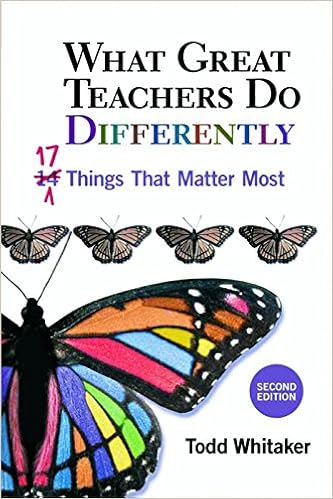
Since the first of the year we have been taking a look at one strategy from Todd Whitaker's book What Great Teachers Do Differently.  This week we will quickly highlight the last 5 strategies and then provide a summary.

Base Every Decision on the Best People - "Before making any decision or attempting to bring about any change, great teachers ask themselves one central question: What will the best people think?" (Whitaker, 88)

In Every Situation Ask Who Is Most Comfortable and Who Is Least Comfortable - "Great teachers continually ask themselves who is most comfortable and who is least comfortable with each decision they make.  They treat everyone as if they were good" (Whitaker, 95)

Put Yourself in Their Position - "Great teachers have empathy for students and clarity about how others see them" (Whitaker, 101)

What About These Darn Standardized Tests - "Great teachers keep standardized testing in perspective.  They focus on the real issue of student learning." (Whitaker, 109)

Make It Cool to Care - "Great teachers care about their students.  They understand that behaviors and beliefs are tied to emotion, and they understand the power of emotion to jump-start change." (Whitaker 118)


Summary
Whitaker's book What Great Teachers Do Differently is a quick read outlining some of the characteristics that set the best teachers a part from the others.  As I finished the book, I tried to summarize a great teacher into one (long) sentence:  A great teacher is someone who cares for kids, keeps kids first in all decisions, treats everyone as if they were good every day, and is empathetic.  Whitaker mentioned when he spoke to the MRVED districts (this is a paraphrase)..."none of these things require money, the newest curriculum, or the fanciest device...all of these things can be accomplished through EFFORT."  It may take a lot of effort some days to treat that one kid as if he was good, but in the end it's worth it.

When I think back to my schooling (and I need to be careful here as some of my teachers are still teaching :-) and remember the great teachers.  I don't remember some of the neat projects we did, or the newest computer games (it was the color version of Oregon Trail), I remember the teachers that treated me with respect and genuinely cared for me.  Some of it was "tough love", but love nonetheless.  Think back to your schooling.  What were some of the characteristics of the best teachers you had?  Do you carry some of those characteristics yourself?  Would you want to be a student in your own classroom?

If you haven't read it already, find a copy of Whitaker's book What Great Teachers Do Differently and read it over the summer.

Friday, April 28, 2017

Summer Reading List

Summer Reading List
With only a month (or less) of school left I thought it would be good to get a list of books to read over the summer months.

What Great Teachers Do Differently - Todd Whitaker

Innovators Mindset - George Couros (MRVED Keynote Speaker Spring 2018)

Teach Like a Pirate - Dave Burgess

On Your Mark - Thomas Guskey

Better Conversations - Jim Knight

50 Myths and Lies That Threaten America's Public Schools - Berliner & Glass


All of these books offer great discussion points and make you think about teaching and learning.  Brandon has read many of these, so if you are looking for something specific, contact him (braymo@mrved.net).

Friday, March 3, 2017

What Great Teachers Do Differently - Be the Filter

Be The Filter
We are about halfway through Todd Whitaker's book "What Great Teachers Do Differently".  The "Be The Filter" chapter is a great chapter for this time of the year.  February, March, and April can be tough months to get through.  Winter is dragging on, there are no breaks in sight, testing is on the horizon, teacher negotiations are ramping up, etc...  Whitaker talks about filtering out the negative to find the positive.

We all know that one person who constantly brings the negative to every conversation, we'll call her Debbie Downer.  Whenever someone asks Debbie how her day is, she starts by saying how bad her day is, or any problems she is having with her students.  If you are in a conversation with her, you need to filter that negative energy out, because it can leech into your mood as well.  If your mood is negative, your students will catch onto it very quickly.

We've also heard Debbie say, "This is the worst group of kids I have ever had".  Her grade level partners agree and also spew this negativity about this certain grade level.  Soon teachers in the grades ahead are fearing this group of kids.  This negative attitude about a certain grade level permeates throughout everything you do.  Be the filter...Filter out this toxic information and approach this grade level as you have every other year, with positive energy.

If you are dealing with a lot of negative people, pick up Whitaker's book and read chapter 10.  He will give you some strategies to filter out the negative and become the positive change you want to be.


Friday, December 16, 2016

Holiday Book Recommendations

Holiday Book Recommendations
If you are looking for a couple books to read over the Christmas break, here is a short list of a couple great books by some excellent authors!

What Great Teachers Do Differently - Todd Whitaker


Better Conversations - Jim Knight


Fair Isn't Always Equal - Rick Wormeli


The Innovators Mindset - George Couros

Thursday, October 13, 2016

What Great Teachers Do Differently - When You Say Something, Mean It

When You Say Something, Mean It
As we continue through the book, "What Great Teachers Do Differently- 17 Things That Matter Most", by Todd Whitaker, we will review the previous 2 weeks.

1. It's People, Not Programs
2. The Power of Expectations

Now we will examine the chapter titled, "If you say something, mean it".  This chapter is exactly as the title describes.  Great teachers follow through with what they say they are going to do.  This chapter focuses primarily on classroom management, but I believe it can apply to all facets of things including, but not limited to, helping organize school events, meeting preparation, attending student events, etc...  It's not about how many things you are involved in or how many events you attend, it's about following through when you say you will do something.

In terms of discipline, if you say there is going to be a consequence, then follow through on your consequence.  If kids know you don't follow through on consequences, they will push you to the limit, thus disrupting quality instructional time.  Whitaker also points out that, although follow through is important, so is how you deal with the misbehavior.  For instance, often times you can acknowledge a behavior, without letting the whole class know you have seen the behavior.  Often times the student misbehaving is seeking attention.  By acknowledging the misbehavior in a loud way, you are giving the student what they want, attention.  So communicating the consequence is often times just as important as following through on the consequence.

"Great teachers manage their classrooms thoughtfully.  When they say something, they mean it (Whitaker, 24)."

Friday, September 30, 2016

What Great Teachers Do Differently - Expectations

Expectations
Last week we started our series on the book "What Great Teachers Do Differently" by Todd Whitaker.  Our topic last week was centered on people being the driving force behind making a school successful, not the programs.  This week we will look at "The Power of Expectations".

Whitaker says "Great teachers focus on expectations.  Other teachers focus on rules" (Whitaker, p.13).  This is an interesting statement and holds a lot of merit.  By setting expectations for our students from the start we are being more proactive in our approach versus always being reactive.

A great example of setting expectations not rules is "Be Respectful".  I'm sure we can all think of 10 rules that can fall under the umbrella of being respectful.  By using expectations, it gives the teacher much more discretion when disciplining a student.  Whereas, many rules have defined consequences.  Sometimes the punishments don't always fit the crime.  By being vague, yet pointed, in your expectations, you can deal with all consequences differently, yet fairly.'

This chapter deals primarily with student behavior in terms of expectations, but I think it can also apply to student learning as well.  Great teachers set high expectations for their students and are not afraid of the work it is going to take to get there.  They are also not afraid of failure, thus allowing themselves to set high expectations for their students.

Too often we set the bar high enough for students to reach it, but never challenge them by setting the bar just out of their reach.  The fear and letdown we experience when a student doesn't reach the bar we have set for them makes us set the bar lower and lower.  We need to have the mindset of the phrase in the image in this post, "Shoot for the moon.  Even if you miss, you'll land among the stars."  This mindset is so important for everyone.  Aim big, have high expectations for all students.