MRVED Business
January 23, 2019 Superintendents' Council
January 25, 2019 Principals' Council - CANCELLED
February 1, 2019 Title III Teachers
February 13, 2019 MRVED Board (6 p.m.)
February 21, 2019 TAC
February 22, 2019 Principals' Council
February 27, 2019 Superintendents' Council
Once again we couldn't fully escape the cold and snow, but overall it was a great day of learning. Around 650 educators participated in the day and great collaboration occurred all day. The MRVED would like to once again thank Lac qui Parle Valley for being such a great host. The custodial staff does a fabulous job in preparing the building for 650 people and the kitchen staff prepares a wonderful meal for everyone. Dave works hard to make sure all the technology is up and running not only throughout the day, but spends a couple hours the weekend prior getting everything ready. Thank you to the administration and staff for allowing all the educators in your building. It's not easy coming back into your classroom at the end of the day to see it torn apart. The MELT committee thanks everyone and even those not mentioned.
MELT Evaluation
The MRVED hopes that all your MELT experience was a great one. There were some awesome sessions presented throughout the whole day. Please take a moment to fill out the MELT 2019 Evaluation. Any and all feedback is appreciated. The MRVED Teacher Advisory Committee (TAC) looks over the evaluations and makes adjustments to the day based upon the feedback. The MRVED Principals and Superintendents also look over the evaluations.
MELT Evaluation
Rethinking Time in Schools

Testing 1,2,3 From MDE
Testing 1,2,3 is created by the Minnesota Department of Education as a resource to help district better utilize the data they are given. The quote from the website is this:
"Test data is an effective tool for informing instruction. This website is designed to help teachers harness that data by providing helpful ways to understand, interpret and ultimately use test data in the classroom."
A quick browse through the website will give you a better idea of what it is all about. This site has been in the works for the past couple years and brings many different aspects of MDE's website into one spot. Bookmark it today!
Tech Tip of the Week - Tilt Brush by Google
In the "this is unbelievable" category, the Tilt Brush by Google is AWESOME! The Tilt Brush allows you to paint in 3D. The Tilt Brush itself is not too expensive, but the 3D goggles can get to be a bit expensive. Check to see if your school has a pair of 3D goggles and then you will want to check out and purchase a Tilt Brush. Imagine putting this in the hands of our kids and the things they can create!Ditch That Textbook - Part 2 (Chapter 8-13) Ditch That Mindset
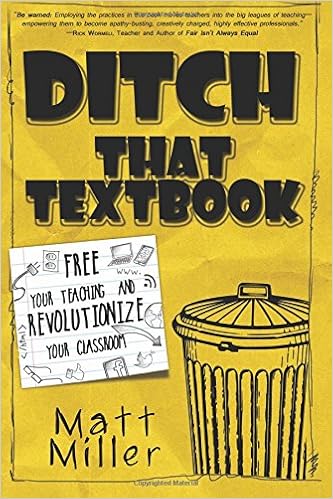
Last time we looked at the first part on "Why Go Digital" in the book Ditch That Textbook by Matt Miller. If you still have not gotten the book, I highly, highly, suggest it! There are SO many great ideas in this book, it really can help you transform your teaching.
We will now look at chapters 8-13 in the section titled "Ditch That Mindset". Miller talks about a variety of things in these chapters so I'll do my best to summarize my learning.
Miller talks about making learning personal for kids. Find a way to connect the content to something relevant in their world. There are many parallels we can make in almost every content area. Think about events in their worlds such as, birthday parties, prom, homecoming, jump rope for heart, etc... Anytime you can personalize learning and connect real-life to content, kids tend to retain that information better. It also makes learning interesting for kids.
Chapter 9 talks about making learning fun. Miller mentions the works of Dave Burgess, which the MRVED had the awesome opportunity to see this past fall. Basically, do what you can to involve your kids in the learning and make it fun for them. Think how boring life would be if school wasn't fun!
Miller continues to talk about building relationships with kids. He mentions that some days you do need to be a kids friend because you are all he/she has. Building positive relationships with kids really does make everything else in the book so much easier. If kids respect and trust you, they will take risks with you. They will help you when you fail. They will encourage you, much like you encourage them.
 The last part to these chapters talks about integrating the technology. Chapters 12 & 13 go hand-in-hand with what I have been talking about the past five years. Choose task over tool and utilize the SAMR model. I compare the task over tool portion to the "Golden Why" by Simon Sinek with the learning objective in the middle as the "why" the tasks in the second ring as the "how" and the tools on the outside as the "what". Lesson plan from the inside out...What is my learning goal? Then, what task do I need to do to accomplish that goal? Lastly, what tool will I use to accomplish both.


